Saturday, November 24, 2007

BOY TROUBLES

A Closer look at the Looming Literacy Debate

By Meredith Stebbins and from the Teaching Matters eNews series

In the 1990s, an alarm began to sound from authors, critics and experts — young boys in America were in trouble. Across all economic and racial backgrounds, boys were lagging behind girls in areas like reading, outnumbering girls in special education classes and more often being prescribed mood-managing drugs. Even now, more than 10 years later, none of these trends have improved. A 2004 National Center for Educational Statistics study analyzed ten years of reading achievement data. At grades 4, 8 and 12, girls consistently performed better. Girls in these grades outperformed boys in writing achievement as well. (Freeman 2004) A fellow at the American Enterprise Institute, Christina Hoff Sommers, states, “I don’t think that anyone will deny that girls are more academically superior as a group…They make the grades, they run the student activities, they are the valedictorians.”

Classrooms - Are They Geared Towards Girls?

Famed author and educational consultant Ralph Fletcher writes in Boy Writers: Reclaiming their Voices, that today’s more restrictive, test- and curriculum- driven classrooms have negatively affected all students, especially boys. In a recent Time Magazine article, David von Drehle elaborates, “Even in the youngest grades, test-oriented teachers focus energy on conventional exercises in reading, writing and other seatwork, areas in which girls tend to excel. At the same time, schools are cutting back science labs, physical education and recess, where the experimental learning styles of boys come into play.” He goes on to say that boys need “mentors and structure, but also some time to experiment.”

Girls vs. Boys - Is There Really a Problem?

Our impulse to compare boys to girls and to measure each gender by the success of the other is, perhaps, the wrong approach. Sarah Mead, former senior policy analyst at the Education Sector (a private think tank largely funded by the Gates Foundation) argues that boys are holding their own overall and, in some cases, even improving on standardized tests; they just are just not improving as quickly as girls. Mead believes that the ‘good news story about the achievements of girls’ has been sensationalized into a ‘bad news story about struggling boys.’ It is entirely possible that girls, as a group, are only now starting to realize their full potential.

The standardized National Assessment of Educational Progress test (also known as the nation’s report card) indicates that by the senior year of high school, however, boys have fallen nearly 20 percentage points behind female peers. Is there cause for concern because boys are so far behind girls or, because many boys are leaving school functionally illiterate?

The Teaching Matters Approach

JT
Animated students like JT (shown here) relate to young urban boys’ sense of humor, interests, and communication style.
Teaching Matters is committed to improving literacy in the New York City public schools and recognizes the need for programs that capture the interest of boys and girls. Over the years we have made the most of what researchers have learned about engaging both genders. In fact, some of the country’s foremost literacy and writing experts serve as our consulting curriculum authors.

Lynette Guastaferro, Executive Director, says, “Teaching Matters is focused on engaging boys and girls in literacy and writing by using technology to make writing relevant to students’ experiences outside of school.” We have developed Writing Matters; a technology-enhanced middle school writing curriculum and professional development program. The program uses story-based animations to help students grasp the critical thinking behind effective writing. Furthermore, it offers students a safe space for writing, collaboration and online publishing that is teacher tested and approved!”

Teachers report that even their struggling students are writing more and persevering through all stages of the writing process. Boys, in particular, have been cited as extremely responsive to the technology-rich writing environment.


Tuesday, November 20, 2007

Put to the Test!

In response to a flawed test booklet (entire article):

“We need to recognize that the testing industry is under immense pressure at a time when scores are being given immense importance,” said Thomas Toch, who wrote a report last year detailing the problems of the American testing industry for Education Sector, an independent policy group, where he is a co-director.

I think its important that the testing company not be discounted on everything else they have done just because they did poorly on one test. Lets not throw the baby out with the bath water. One test should not make or break a company only k-12 kids should be held to such standards. Testing companies are doing so much good driving the non-critical thinking curriculum. Without these privateers of the American education system where would the media get all the sheep to lead to the consumer slaughter? We need these company's to inform teachers of what needs to be taught. Maybe if we divert more funds from the classroom, companies will do better?


Read the rest of the article!

http://www.nytimes.com/2007/11/20/education/20test.html?ref=education

Saturday, November 17, 2007

The Role of the Teacher, Part Deux

The role of the teacher. Great question, with so many answers...More angles, as my favorite college professor used to say "than a 4 way cold tablet."

As I write this post, I do so with some strong feelings towards some of my co-workers, A couple of days ago, I emailed my team...

In the interest of trying to further my advisees' progress, I was wondering if it would be possible if we could communicate with one another regarding assignments. Many of my guys (we have single sex advisories) don't know what their HW assignments are, or when major projects are due. If we could create a system, through email, blogging, etc. where they would be listed, even on a day-to-day basis, that would be great. I know, they're supposed to do this themselves, but reality is what it is.

I have no intention of coddling my advisees. My point was to figure out what they need to do, and make sure it gets done.

To which, I've received the following responses...

"If they cant take 2 seconds to write down their assignments when i mention them several times in class, then they deserve the zero for the work they don't do. They have to learn some responsibility."

"they're 10th graders."

What does that mean? They're a bunch of (sometimes) goofy, confused, scared, angry, frustrated 15 and 16 year-olds who, for the most part have been completely disenfranchised by the school system, whose parents have been just as disenfranchised, or don't have the means, ability, time or responsibility themselves to help them. A system that our school was DESIGNED AND CREATED TO FIGHT AGAINST!!! Moreover, if these kids don't graduate, or drop out, the entire purpose of our school, and the small school movement, is for naught.

Does receiving "zero" teach responsibility? Maybe. Or, to the kids who've lived with the zero their whole lives, is it just more reinforcement that school isn't for them? Of course, deadlines are important. As adults, don't we get reminders about bills being due, and the like? Does anyone really believe these kids come to school everyday because they want to fail?

I'd like to hear some feedback on this, and appreciate the forum that's been established to air things like this.

Monday, November 12, 2007

What is the Role of a Teacher?


Are we to facilitate the lucrative test company's heavily lobbied NCLB law? Is my job to help children pass standardized exams? Exams that even the author's own children do not take? Am I being charged with creating a class of student who follow directions and complete tasks well without asking why? Is my job to remove any iota of critical thinking from my coursework?

or


Are we trusted as educators to do what is best for the students?

How can I sit back and give tacit consent to Regents exams, when I know they are only in place to maintain a class structure? Will the students forgive me for distributing a test designed to be a hurdle in their academic life? Will I be able to forgive myself for becoming part of the system that filters out large swaths of students? Will the students who fail these exams wonder why the school system based their entire diploma on a set of exams?

Can teacher's be conscientious objectors to the standardized testing process?

A colleague of mine visited Kohl's Department store the other day and saw a former student working behind the counter. The student and teacher were very excited about the meeting. The student was working very hard behind the register it was the start of the holiday shopping season.

"So, Bill how are you doing?" asked the teacher.
"I'm great, I think about you guys at QHST allot..." exclaimed the student.
"Where are you going to school?", said the teacher.
"I didn't graduate. I didn't pass the US history Exam...", explained the student.
The teacher only replied with an, "Oh..."

What are we doing to these students? How does this happen?

Thursday, November 08, 2007

What Will They Carry?

The last two days of teaching have been unforgettable experiences for me. On Wednesday Mayo and I had invited guest speakers from Veterans for Peace into speak about choices after high school and the importance of critical thinking. Jim Murphy and Dayl Wise entranced the students with their stories they carried with them home from Vietnam.

Mayo's seniors have been reading Tim O'Brien's "The Things They Carried". The speakers engaged the class in "self to text" discussions making many references directly to the book during the talk. Both Dayl and Jim were impressed with the level of discussion and questioning our seniors had attained. They visit many schools and were taken aback by our students. The dialog about the book between the students and the speakers was natural and genuine and speaks to the culture of reading we are establishing in the building.

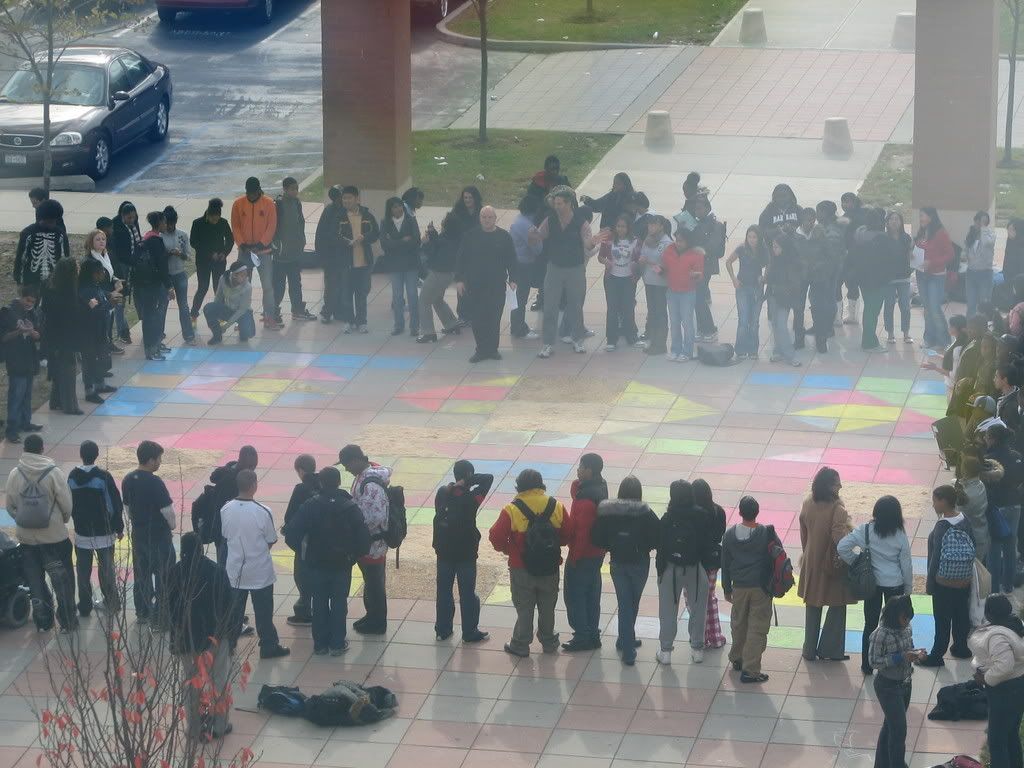
The second unforgettable moment was the culminating event my students worked on from their unit on Hinduism in Early India. Students, teachers, and paras created a piece of Rangoli art. The students were able to experience a communal art project and through this have a greater appreciation for the Hindu culture.


Why are you writing about this Brown?

Believe it or not I'm always afraid of doing things that are hard to measure through traditional means. ( I know this is hard to believe) I take my job quite seriously and I do not want to do a disservice to anyone. I was stressing over the time that was going into the event. Gathering all the freshmen during one period is no simple feat. The thing that stuck with me the most was a side comment Mayo made to me during the event. Mayo in her passionate "non-smoking manner" explained to me that these expereinces (guest speakers and communal celebrations) are the ones that students remember."

She was half right. I think they are the things that teachers remember too.

Monday, November 05, 2007

Report Cards

I think its interesting that school administrators in a recent New York Times article are complaining that grades do not do justice to what schools are doing. These school report cards will not reflect any whole school. Teacher grades for students are due this week. Do our grades reflect our whole student? Quantifying quality is not easy.

“It is just so demoralizing to have a number or grade assigned that is just sort of trivializing things,” Ms. Foote said. “It doesn’t reflect, I think, the valuable work and the very complicated work that we do here.”

Throughout the city, principals are bracing for the release this week of report cards from the Education Department that will, for the first time, grade schools on a scale of A through F. Because the report cards will assess schools on how much individual students improve year to year, as well as on a complicated mixture of test scores and other factors, many of the grades are likely to upend longstanding reputations, casting celebrated schools as failures and lauding those that work miracles with struggling students. Some principals refer to the scores as a “scarlet letter.”

READ MORE


Look up a school's grade HERE


Saturday, November 03, 2007

Working Together


Recently the idea of Co-Teaching seems to be under scrutiny in our school. I question where this is coming from. Rather than "trusting" administrators we should trust each other. And if we have doubts we should visit each other's classes. From what I heard in the past, and experienced myself, some of the most effective classes have been co-taught classes.

Eg. 1 SCART. Science and ART. When I first came to QHST Varriale and Fox shared the products and the accolades of the co-taught science and art class from the year past. I was impressed with the outcomes and the freedom teachers had. I was also impressed with the level of respect each teacher had for each other. It seemed that using the time in an effective manner was an appropriate use.

Eg. 2 Current Events. Swetten and I co-taught a three period elective on current events. Woolsey and O'Malley observed this and can both testify as to how effective this class was. Students were asked to present each week and deep philosophical issues guised in the veil of current events were being discussed each class. We infused technology. Each teacher worked to the best of their abilities and the result was something the seniors who were freshmen at the time still talk about today.

Admittedly this doesn't always work as smoothly. Teachers need time to plan. We don't always get stuck in an elevator together. Yet despite the common planning time the "Journal" class being created with Bachinsin and Mayo looks simply amazing. Students are given an opportunity to express themselves through art and written expression.


Conversely teaching one period electives to students who have hole in their program can be a nightmare. I'll never forget the various "PROJECT LEARN" classes. I still to this day have a one period elective named "Research and Technology". Admittedly its quite hard for me to remain motivated for this class even though its probably the one topic I hold dear to my heart. Students don't want to be there, its early and seniors are aware we are just filling holes. Hopefully in the future we could at least consider a schedule that allows for real electives. Hopefully re-considering past proposed schedules is on the horizon.

Sunday, October 28, 2007

Shih Shares

A colleague recently sent me this YouTube video. Ironically if you are on a Department of Ed computer you can't watch it though.


Not Who But What Is Left Behind


When I think of the things I remember most from school it was 8th grade science class with Ms Ambrosio. She would let be excused from all my other classes all day and help her with science lab. She was probably the most kind woman I ever met. She gave every student ample opportunity to succeed. I regret I never got in touch with her after I realized how important she was to me. I also will also never forget when Bro. Dicowski and Bro. Guillen shook my dad's hand at my High School graduation. I really never felt a part of my high school until that day. In college I befriended Professor Nieter at St. John's University and had a unique experience of how a man allowed his passion for science drive him to inspire groups of volunteers to learn through his modeling, and embrace the delicate wetlands that remarkably can thrive in urban settings. All of these things I carry with me into the classroom.

Why am I writing this? Who cares? Read the following:


Not Who But What Is Left Behind

By Barbara M. Stock


Our national obsession with standardized-test scores is dangerous. The idea that there is only One Right Answer, the answer to the test question, plants the seeds of authoritarian rule. Standardized tests encourage a standardized way of thinking. If there is only one right answer, there is no need to think, to question, to discuss. We breed compliance and complacency. We see challenges to authority as disloyal. The foundations of democracy break down.

I was shocked into this realization when my grandson phoned with a homework question. "What did you learn in school that helps you be a good citizen?" he asked. His question stopped me. A good citizen? In my day, teachers graded us for citizenship. A high grade meant the student was quiet. I was always talking. I earned high grades for academics, but for citizenship-unsatisfactory. It didn't matter. It didn't count in our grade point average, and GPA was what mattered. Citizenship was an empty word.

I grew up in the '50s, the era of the white picket fence and the gray flannel suit. We lived in fear-of Communism, of a Soviet invasion, of nuclear bombs. We stored canned goods in the basements of our homes and sat on the floor of the school basement with our heads between our legs for air-raid drills. Education was lock-step. In science class, we memorized a list of birds common to North America. The test required us to simply write the list. We never even saw pictures of these birds to match with the names. In English, we memorized rules of grammar. In history, we memorized dates, names of battles, names of colonies, names of presidents. There was only one right answer, and that was the answer that would get us an A on the test. I needed A's. As a first-generation American, I needed to get to college. I needed to succeed. Being a good American citizen meant getting a job and getting rich.
------------------------
SIDEBAR: Creating good American citizens rests on the character of our teachers-not the facts they teach, but who they are and how they teach.
------------------------
But America paid the price for One Right Answer. In the '50s, authorities often viewed with distrust those who questioned. In order to be heard, questioners shouted; confrontations became violent. The decade that followed was a decade of open rebellion. The civil rights movement, the feminist movement, the anti-war movement-all sprang from folks saying, "Don't tell me what to do. I can think for myself."

Education had to change, and it did. I was excited to see my children attend schools that encouraged them to think, to question, to listen and discuss various points of view, to learn how to learn. But our current overemphasis on standardized tests, penalizing teachers whose students don't perform well, pressuring students to learn the right answer-these are major steps backward.

I value good American citizens. I don't like orange alerts; they remind me of my childhood air-raid drills. I want to feel safe. I want to trust my neighbors. I want my children and grandchildren to feel secure and trusting. But back to my grandson's question: What did I learn in school that helped me become a good citizen? How did I learn the values underlying my loyalty and commitment to America?

First, I learned to think and ask questions, not from the lock-step teachers, but from the exceptions. Daily, on my way out the door to school, my mother reminded me, "If there's anything you don't understand, ask the teacher." My 2nd grade teacher, Miss Siegel, taught us how to think. She asked questions and pushed our class to think outside the facts. "What will happen if �" and "How would you like this story to end?" were heard regularly. Miss Pelaez, my junior high school English teacher, passed out blank paper and urged us to "write what comes to mind." She was undaunted by the McCarthy era. She did not worry about our thinking or writing something un-American. She validated free thinking.

I remember the day Mrs. Josephs, my high school English teacher, was called out of class to the principal's office. She had assigned For Whom the Bell Tolls; the principal told her to cancel the assignment because the text was sexually explicit. Instead, she posted a list of pages (with the sexiest scenes) and told us not to read them. That day I learned how to use creativity and humor under fire. I saw how she thought and worked with, not against, people holding different views.
I recall Mr. Morse, a college professor who had a strong belief in his students' ability to think. His classroom was silent; he listened intently to each student, and by his behavior taught us to listen to each other. That skill is invaluable to me in raising my family, building close relationships, and certainly in becoming an informed citizen.
----------------------------
SIDEBAR: If there is only one right answer, there is nothing to be curious about.
-----------------------------
Second, I learned to develop a healthy emotional attitude. I appreciate Miss Allen, my junior high school vice principal, who welcomed me into her office and allowed me to vent. I was no good at conforming. I was hard on myself and angry toward others. I felt left out of cliques. I hated losing competitions. She took time to listen. She knew if I remained hurt, I would lash out and hurt others. Instead, she handed me Kleenex, often suggested a different perspective, and sent me back to class kinder to myself and to others. Teaching students to regurgitate answers overlooks the emotional needs of children. A good citizen must respond to those who are hurting. Otherwise, we risk their rage and are horrified at the current epidemic of youth violence.

Third, from all these teachers I learned to value an open mind. But permission to be curious, I learned first from Miss Aiken, my kindergarten teacher. With no pressures of accountability and progress, she allowed me to sit for hours on the window seat studying rainbows in cut crystals. I'm still as curious-about new ideas, new people. If there is only one right answer, there is nothing to be curious about.

How did I learn to be a good citizen? Not by staying silent in class. Not by memorizing facts. Creating good American citizens rests on the character of our teachers-not the facts they teach, but who they are and how they teach. In our time of "no child left behind," which places tremendous emphasis on standardization, I fear that the essential lessons for becoming a good American are precisely what are being left behind. I've yet to see a tombstone marking a grade point average or an SAT score.
----------------------
Barbara M. Stock is a clinical psychologist in private practice who has consulted on K-12 school programs and taught at the college level. She lives in Wilmette, Ill.


Joanna Vogel former QHST student has posted the following on her blog. The version I have here was found at mathforum.org .


Parent Teacher Conferences and the Internet


Using Teacherease.com (paid for by a non-profit ISA) has changed the parent teacher conference experience. Parents are already fully aware of the "grades" their children have so meetings must find a new topic of conversation. The conversation between myself and parents now seems to focus on strategies to access the skills their children have or improving those skills that their children are still struggling with. Granted some parents are still here to argue and vent but shifting the focus of the conversation is much easier that the veil of secrecy has been lifted from my grade book.

No parent seemed shocked by their visit. Most parents raved about the open communication the freshmen team has through constant electronic contact.(Unfortunately, one parent did not have an email address).

One thing that I did walk away with this year was that the parents and students are looking at the online grade book much more than before. (I've been using this for the past six years) As a result of an increased volume of readership of my grade book, I feel an added stress. It is a stress of accountability. I need to be more diligent in updating information on the site. I am confident that ultimately , it will make me a better teacher.