Showing posts with label philosophy. Show all posts

Sunday, February 17, 2008

Are "we" Ready


Recently on another teacher blog (Weblogg-ed) teachers are ranting about the new skill sets our students will be asked to tackle. I wonder what we are doing currently in our classrooms to enhance these skills? Are we as successful products "traditional" skill set value system ready to make a paradigm shift?

This following is excerpted: [entire post]


Our kids’ futures will require them to be:


  • Networked–They’ll need an “outboard brain.”

  • More collaborative–They are going to need to work closely with people to co-create information.

  • More globally aware–Those collaborators may be anywhere in the world.

  • Less dependent on paper–Right now, we are still paper training our kids.

  • More active–In just about every sense of the word. Physically. Socially. Politically.

  • Fluent in creating and consuming hypertext–Basic reading and writing skills will not suffice.

  • More connected–To their communities, to their environments, to the world.

  • Editors of information–Something we should have been teaching them all along but is even more important now.

Tuesday, November 27, 2007

How to Prevent Another Leonardo da Vinci

http://wanderingink.wordpress.com/2007/05/23/how-to-prevent-another-leonardo-da-vinci/


While surfing other "teacher blogs" I came across this posting by Kris Bradburn. The following article which Kris Bradburn wrote has been nominated for online awards and this website is something I am adding to my "google reader"


This is how we kill each trait that may yield another Da Vinci:

1. Curiosita (from “How to Think Like Leonardo da Vinci”)
What? Intense and insatiable curiosity; constantly learning due to a desire to ask and answer questions
The Murder: In schools, for the most part, students learn only what the teacher decides they will learn. Student questions will often go unanswered if they lead away from the material (go off-topic), or if there are time constraints on what must be learned that leave no time for these questions in class.

2. Dimostrazione (from “How to Think Like Leonardo da Vinci”)
What? Constant testing of knowledge through experience and persistence; accepting of and learning from mistakes
The Murder: Except in the sciences (and sometimes even then), knowledge is simply given and expected to be absorbed rather than questioned and tested. On tests and labs, wrong answers cost the students their grades, therefore it becomes unacceptable to make mistakes. Mistakes are less about learning experiences and more about losing marks. Questioning societal norms is a very negative thing, even if they don’t make sense.

3. Sensazione (from “How to Think Like Leonardo da Vinci”)
What? Fully noticing and observing things with all senses, but especially sight (seeing things that others miss, seeing the details)
The Murder: Except in the sciences and a handful of other subjects, students are usually taught passively through the use of only one sense, listening, or maybe sight (diagrams, photos, etc.). Classrooms and assignments may be incredibly unstimulating to most (or all) senses.

4. Sfumato (from “How to Think Like Leonardo da Vinci”)
What? An acceptance of ambiguity, paradox, and uncertainty out of a realization that life is not black and white (also an art technique using shadow famous for its use in da Vinci’s paintings)
The Murder: A student’s answer is either right or wrong, usually with no middle ground tolerated. Standardized tests are mostly multiple choice, and in the case of an ambiguous result, students must choose the best possible answer, not a possible answer, even though more than one is really correct. Life and its problems have more than one right answer; multiple choice questions have only one best answer.

5. Arte/Scienza (From “How to Think Like Leonardo da Vinci”)
What? Interest in both the arts and sciences and interdisciplinary work that combines them
The Murder: High school courses are most often strictly defined as an “Art” or a “Science”, and they never mingle; interdisciplinary courses at this level are rare. In college, an undergraduate usually receives a either Bachelor of Arts or a Bachelor of Science, though there is more flexibility here than in high school. Scientists and artists have their own professional domains which almost never overlap.

6. Corporalita (from “How to Think Like Leonardo da Vinci”)
What? Keeping one’s body in good shape; attending to nutrition, fitness, and general physical well-being
The Murder: Physical Education programs - especially in the United States - are being severely cut, and obesity has been described as an epidemic. Junk food is readily available and sometimes may be the only option in a high school cafeteria. Fast food is cheaper and more convenient than healthier food ($4 for an entire meal at McDonald’s or $4 for a single, small-sized fruit bowl?).

7. Connessione (from “How to Think Like Leonardo da Vinci”)
What? Acceptance and appreciation for the interconnectedness of everything in life; interdisciplinary approaches and thinking
The Murder: Facts and concepts are taught in specific classes that are independent of each other, and students are moved from individual class to individual class without knowledge of how the two might be connected. Boundaries like that between art and science are rarely crossed or their connectedness even explained. Facts and ideas might be taught with no explanation of the links between them (ie, learning individual details and facts but not the big picture).

8. Drive, energy, intense focus (from various studies on creative genius)
What? Energy and desire to focus intensely on one’s work and interests (often the same thing); merging of work and play
The Murder: Each class is allotted a certain period of time that is inflexible. Despite the student’s interest in a particular class, they must conform to this schedule. Many schools have required curriculum that force a student to give up desirable or necessary electives for core classes they may not need. Students must go to school and all perform well academically, despite their individual talents and aspirations. Musicians and artists especially must break focus on their real interests to attend required academic classes, and may be too drained to work on their own by the end of the school day.

9. Confidence, willingness to take risks, and tolerance of failure (from various studies on creative genius)
What? Willing to continue on with creative work despite rejection; ability to sell oneself and one’s talents
The Murder: Many creative people must face multiple rejections until their idea is sold, and they must accept that if their idea or creative contribution is too radical, society may not yet be ready for it (many artists and writers have only been recognized after their deaths). However, as mentioned above, mistakes and failure are not tolerated in schools and this learned attitude may carry on throughout life. Instead of learning the value of taking risks, students are taught to fear any mistakes that might result. Students are often “babied” - all team mates get a ribbon or a trophy for “participation” - and do not gain the real-world skills they need to sell themselves.

10. Independence, introversion (from various studies on creative genius)
What? Willingness to spend lots of time alone working and honing skills; acceptance of possible isolation
The Murder: The social climate of high school severely discourages spending time alone, especially when spent “working”, and loners are isolated and considered antisocial and friendless. Refusing to conform and “sticking out from the crowd” is highly discouraged by peers and teachers. Creative individuals may have to accept that if the world is not ready for their ideas, they may find few people who understand and support them.

This is how we kill the spirits of our up-and-coming da Vincis. These ten things are the most commonly cited characteristics of highly creative people… and they’re heavily discouraged in the early years by the education system and social climate of adolescence. This is why we won’t see another da Vinci for a long, long time - or why, if we do, he/she would not have come from the system we currently have in place. At every turn schools and society are set on pushing back the most creative individuals. Their common traits are not welcomed nor encouraged, and certainly not nurtured. This must not persist, because I think the world is long overdue for another da Vinci-type right now.

I would love readers to share their thoughts!!!!!!!!!!!!!!!!

Tuesday, November 20, 2007

Put to the Test!

In response to a flawed test booklet (entire article):

“We need to recognize that the testing industry is under immense pressure at a time when scores are being given immense importance,” said Thomas Toch, who wrote a report last year detailing the problems of the American testing industry for Education Sector, an independent policy group, where he is a co-director.

I think its important that the testing company not be discounted on everything else they have done just because they did poorly on one test. Lets not throw the baby out with the bath water. One test should not make or break a company only k-12 kids should be held to such standards. Testing companies are doing so much good driving the non-critical thinking curriculum. Without these privateers of the American education system where would the media get all the sheep to lead to the consumer slaughter? We need these company's to inform teachers of what needs to be taught. Maybe if we divert more funds from the classroom, companies will do better?


Read the rest of the article!

http://www.nytimes.com/2007/11/20/education/20test.html?ref=education

Saturday, November 17, 2007

The Role of the Teacher, Part Deux

The role of the teacher. Great question, with so many answers...More angles, as my favorite college professor used to say "than a 4 way cold tablet."

As I write this post, I do so with some strong feelings towards some of my co-workers, A couple of days ago, I emailed my team...

In the interest of trying to further my advisees' progress, I was wondering if it would be possible if we could communicate with one another regarding assignments. Many of my guys (we have single sex advisories) don't know what their HW assignments are, or when major projects are due. If we could create a system, through email, blogging, etc. where they would be listed, even on a day-to-day basis, that would be great. I know, they're supposed to do this themselves, but reality is what it is.

I have no intention of coddling my advisees. My point was to figure out what they need to do, and make sure it gets done.

To which, I've received the following responses...

"If they cant take 2 seconds to write down their assignments when i mention them several times in class, then they deserve the zero for the work they don't do. They have to learn some responsibility."

"they're 10th graders."

What does that mean? They're a bunch of (sometimes) goofy, confused, scared, angry, frustrated 15 and 16 year-olds who, for the most part have been completely disenfranchised by the school system, whose parents have been just as disenfranchised, or don't have the means, ability, time or responsibility themselves to help them. A system that our school was DESIGNED AND CREATED TO FIGHT AGAINST!!! Moreover, if these kids don't graduate, or drop out, the entire purpose of our school, and the small school movement, is for naught.

Does receiving "zero" teach responsibility? Maybe. Or, to the kids who've lived with the zero their whole lives, is it just more reinforcement that school isn't for them? Of course, deadlines are important. As adults, don't we get reminders about bills being due, and the like? Does anyone really believe these kids come to school everyday because they want to fail?

I'd like to hear some feedback on this, and appreciate the forum that's been established to air things like this.

Monday, November 12, 2007

What is the Role of a Teacher?


Are we to facilitate the lucrative test company's heavily lobbied NCLB law? Is my job to help children pass standardized exams? Exams that even the author's own children do not take? Am I being charged with creating a class of student who follow directions and complete tasks well without asking why? Is my job to remove any iota of critical thinking from my coursework?

or


Are we trusted as educators to do what is best for the students?

How can I sit back and give tacit consent to Regents exams, when I know they are only in place to maintain a class structure? Will the students forgive me for distributing a test designed to be a hurdle in their academic life? Will I be able to forgive myself for becoming part of the system that filters out large swaths of students? Will the students who fail these exams wonder why the school system based their entire diploma on a set of exams?

Can teacher's be conscientious objectors to the standardized testing process?

A colleague of mine visited Kohl's Department store the other day and saw a former student working behind the counter. The student and teacher were very excited about the meeting. The student was working very hard behind the register it was the start of the holiday shopping season.

"So, Bill how are you doing?" asked the teacher.
"I'm great, I think about you guys at QHST allot..." exclaimed the student.
"Where are you going to school?", said the teacher.
"I didn't graduate. I didn't pass the US history Exam...", explained the student.
The teacher only replied with an, "Oh..."

What are we doing to these students? How does this happen?

Thursday, November 08, 2007

What Will They Carry?

The last two days of teaching have been unforgettable experiences for me. On Wednesday Mayo and I had invited guest speakers from Veterans for Peace into speak about choices after high school and the importance of critical thinking. Jim Murphy and Dayl Wise entranced the students with their stories they carried with them home from Vietnam.

Mayo's seniors have been reading Tim O'Brien's "The Things They Carried". The speakers engaged the class in "self to text" discussions making many references directly to the book during the talk. Both Dayl and Jim were impressed with the level of discussion and questioning our seniors had attained. They visit many schools and were taken aback by our students. The dialog about the book between the students and the speakers was natural and genuine and speaks to the culture of reading we are establishing in the building.

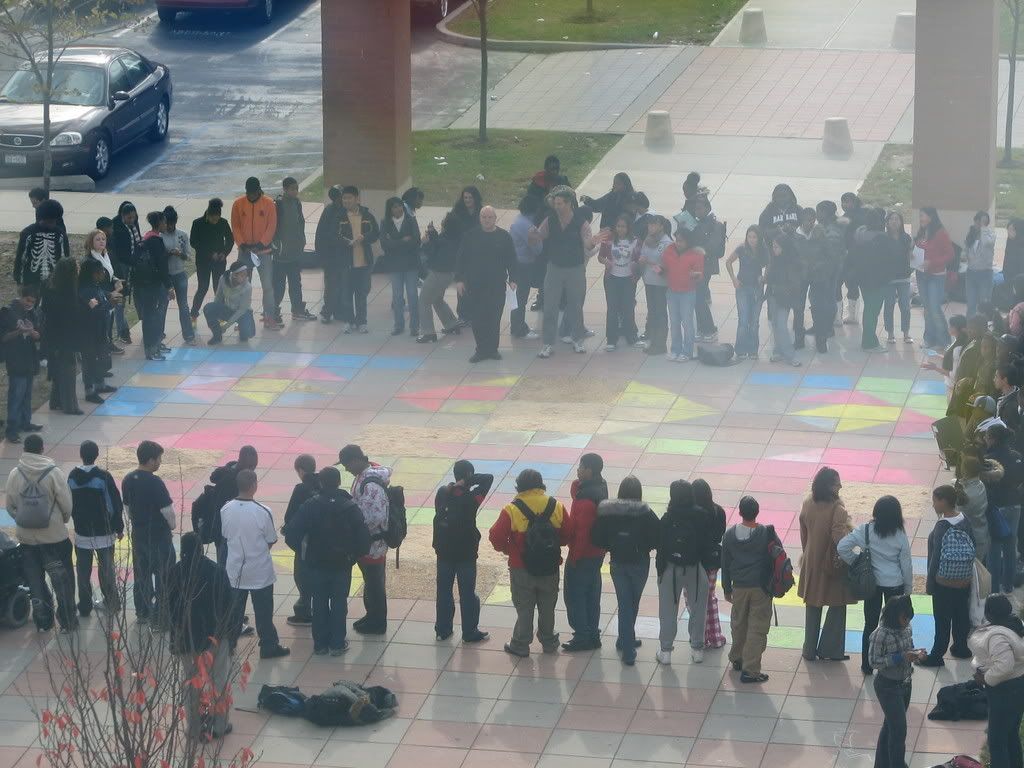
The second unforgettable moment was the culminating event my students worked on from their unit on Hinduism in Early India. Students, teachers, and paras created a piece of Rangoli art. The students were able to experience a communal art project and through this have a greater appreciation for the Hindu culture.


Why are you writing about this Brown?

Believe it or not I'm always afraid of doing things that are hard to measure through traditional means. ( I know this is hard to believe) I take my job quite seriously and I do not want to do a disservice to anyone. I was stressing over the time that was going into the event. Gathering all the freshmen during one period is no simple feat. The thing that stuck with me the most was a side comment Mayo made to me during the event. Mayo in her passionate "non-smoking manner" explained to me that these expereinces (guest speakers and communal celebrations) are the ones that students remember."

She was half right. I think they are the things that teachers remember too.

Saturday, November 03, 2007

Working Together


Recently the idea of Co-Teaching seems to be under scrutiny in our school. I question where this is coming from. Rather than "trusting" administrators we should trust each other. And if we have doubts we should visit each other's classes. From what I heard in the past, and experienced myself, some of the most effective classes have been co-taught classes.

Eg. 1 SCART. Science and ART. When I first came to QHST Varriale and Fox shared the products and the accolades of the co-taught science and art class from the year past. I was impressed with the outcomes and the freedom teachers had. I was also impressed with the level of respect each teacher had for each other. It seemed that using the time in an effective manner was an appropriate use.

Eg. 2 Current Events. Swetten and I co-taught a three period elective on current events. Woolsey and O'Malley observed this and can both testify as to how effective this class was. Students were asked to present each week and deep philosophical issues guised in the veil of current events were being discussed each class. We infused technology. Each teacher worked to the best of their abilities and the result was something the seniors who were freshmen at the time still talk about today.

Admittedly this doesn't always work as smoothly. Teachers need time to plan. We don't always get stuck in an elevator together. Yet despite the common planning time the "Journal" class being created with Bachinsin and Mayo looks simply amazing. Students are given an opportunity to express themselves through art and written expression.


Conversely teaching one period electives to students who have hole in their program can be a nightmare. I'll never forget the various "PROJECT LEARN" classes. I still to this day have a one period elective named "Research and Technology". Admittedly its quite hard for me to remain motivated for this class even though its probably the one topic I hold dear to my heart. Students don't want to be there, its early and seniors are aware we are just filling holes. Hopefully in the future we could at least consider a schedule that allows for real electives. Hopefully re-considering past proposed schedules is on the horizon.

Sunday, October 28, 2007

Not Who But What Is Left Behind


When I think of the things I remember most from school it was 8th grade science class with Ms Ambrosio. She would let be excused from all my other classes all day and help her with science lab. She was probably the most kind woman I ever met. She gave every student ample opportunity to succeed. I regret I never got in touch with her after I realized how important she was to me. I also will also never forget when Bro. Dicowski and Bro. Guillen shook my dad's hand at my High School graduation. I really never felt a part of my high school until that day. In college I befriended Professor Nieter at St. John's University and had a unique experience of how a man allowed his passion for science drive him to inspire groups of volunteers to learn through his modeling, and embrace the delicate wetlands that remarkably can thrive in urban settings. All of these things I carry with me into the classroom.

Why am I writing this? Who cares? Read the following:


Not Who But What Is Left Behind

By Barbara M. Stock


Our national obsession with standardized-test scores is dangerous. The idea that there is only One Right Answer, the answer to the test question, plants the seeds of authoritarian rule. Standardized tests encourage a standardized way of thinking. If there is only one right answer, there is no need to think, to question, to discuss. We breed compliance and complacency. We see challenges to authority as disloyal. The foundations of democracy break down.

I was shocked into this realization when my grandson phoned with a homework question. "What did you learn in school that helps you be a good citizen?" he asked. His question stopped me. A good citizen? In my day, teachers graded us for citizenship. A high grade meant the student was quiet. I was always talking. I earned high grades for academics, but for citizenship-unsatisfactory. It didn't matter. It didn't count in our grade point average, and GPA was what mattered. Citizenship was an empty word.

I grew up in the '50s, the era of the white picket fence and the gray flannel suit. We lived in fear-of Communism, of a Soviet invasion, of nuclear bombs. We stored canned goods in the basements of our homes and sat on the floor of the school basement with our heads between our legs for air-raid drills. Education was lock-step. In science class, we memorized a list of birds common to North America. The test required us to simply write the list. We never even saw pictures of these birds to match with the names. In English, we memorized rules of grammar. In history, we memorized dates, names of battles, names of colonies, names of presidents. There was only one right answer, and that was the answer that would get us an A on the test. I needed A's. As a first-generation American, I needed to get to college. I needed to succeed. Being a good American citizen meant getting a job and getting rich.
------------------------
SIDEBAR: Creating good American citizens rests on the character of our teachers-not the facts they teach, but who they are and how they teach.
------------------------
But America paid the price for One Right Answer. In the '50s, authorities often viewed with distrust those who questioned. In order to be heard, questioners shouted; confrontations became violent. The decade that followed was a decade of open rebellion. The civil rights movement, the feminist movement, the anti-war movement-all sprang from folks saying, "Don't tell me what to do. I can think for myself."

Education had to change, and it did. I was excited to see my children attend schools that encouraged them to think, to question, to listen and discuss various points of view, to learn how to learn. But our current overemphasis on standardized tests, penalizing teachers whose students don't perform well, pressuring students to learn the right answer-these are major steps backward.

I value good American citizens. I don't like orange alerts; they remind me of my childhood air-raid drills. I want to feel safe. I want to trust my neighbors. I want my children and grandchildren to feel secure and trusting. But back to my grandson's question: What did I learn in school that helped me become a good citizen? How did I learn the values underlying my loyalty and commitment to America?

First, I learned to think and ask questions, not from the lock-step teachers, but from the exceptions. Daily, on my way out the door to school, my mother reminded me, "If there's anything you don't understand, ask the teacher." My 2nd grade teacher, Miss Siegel, taught us how to think. She asked questions and pushed our class to think outside the facts. "What will happen if �" and "How would you like this story to end?" were heard regularly. Miss Pelaez, my junior high school English teacher, passed out blank paper and urged us to "write what comes to mind." She was undaunted by the McCarthy era. She did not worry about our thinking or writing something un-American. She validated free thinking.

I remember the day Mrs. Josephs, my high school English teacher, was called out of class to the principal's office. She had assigned For Whom the Bell Tolls; the principal told her to cancel the assignment because the text was sexually explicit. Instead, she posted a list of pages (with the sexiest scenes) and told us not to read them. That day I learned how to use creativity and humor under fire. I saw how she thought and worked with, not against, people holding different views.
I recall Mr. Morse, a college professor who had a strong belief in his students' ability to think. His classroom was silent; he listened intently to each student, and by his behavior taught us to listen to each other. That skill is invaluable to me in raising my family, building close relationships, and certainly in becoming an informed citizen.
----------------------------
SIDEBAR: If there is only one right answer, there is nothing to be curious about.
-----------------------------
Second, I learned to develop a healthy emotional attitude. I appreciate Miss Allen, my junior high school vice principal, who welcomed me into her office and allowed me to vent. I was no good at conforming. I was hard on myself and angry toward others. I felt left out of cliques. I hated losing competitions. She took time to listen. She knew if I remained hurt, I would lash out and hurt others. Instead, she handed me Kleenex, often suggested a different perspective, and sent me back to class kinder to myself and to others. Teaching students to regurgitate answers overlooks the emotional needs of children. A good citizen must respond to those who are hurting. Otherwise, we risk their rage and are horrified at the current epidemic of youth violence.

Third, from all these teachers I learned to value an open mind. But permission to be curious, I learned first from Miss Aiken, my kindergarten teacher. With no pressures of accountability and progress, she allowed me to sit for hours on the window seat studying rainbows in cut crystals. I'm still as curious-about new ideas, new people. If there is only one right answer, there is nothing to be curious about.

How did I learn to be a good citizen? Not by staying silent in class. Not by memorizing facts. Creating good American citizens rests on the character of our teachers-not the facts they teach, but who they are and how they teach. In our time of "no child left behind," which places tremendous emphasis on standardization, I fear that the essential lessons for becoming a good American are precisely what are being left behind. I've yet to see a tombstone marking a grade point average or an SAT score.
----------------------
Barbara M. Stock is a clinical psychologist in private practice who has consulted on K-12 school programs and taught at the college level. She lives in Wilmette, Ill.


Joanna Vogel former QHST student has posted the following on her blog. The version I have here was found at mathforum.org .


Sunday, October 21, 2007

Teacher Incentives


The Following appeared in the NY Times:


"The New York City plan is not a straightforward arrangement, in which individual teachers throughout a school system receive extra money based on the performance of their students. Rather, bonuses equivalent to $3,000 per teacher will be given to schools that meet overall performance standards.

Four-member “compensation committees” at each school, consisting of two teachers, the principal and a principal’s appointee, will decide how to divide the money. They can reward everyone equally or give more money to the teachers whose students’ scores rise the most.

The program is starting this year in 200 schools with high concentrations of poor children. It is expected to reach 400 schools next year. The schools have not been named yet.

So how, exactly, will the prospect (but not the guarantee) of earning $3,000 (or possibly earning far more, or nothing at all) change teachers’ decisions and behavior?"


OK here is my take on this... Is this implying that we as teachers are not doing enough already? Is a carrot going to make us run faster? I'm doing the best I can carrot or no carrot. The underlying assumption here seems to be that we as teachers can work harder if given more money. Show me the teacher that steps back and says, "Well if they paid me $3000 more I'd get them to pass." I think this is a union busting tactic and an insult to our profession.

Monday, October 15, 2007

Power and Voice in the Classroom


"Children learn to make good decisions by making
decisions, not by following directions."


-Alfie Kohn

I have always started my lessons or unit off with a question. A question I created, a question I thought was intriguing, a question broad enough that it’s answer could possibly used as part of a response to a thematic essay on a global studies regents exam.

The original question proposed by a teacher should only be a starting point though. If we don’t allow “student voice” we are silencing half of a conversation in our classrooms. When teachers are hell bent on students answering “teacher questions” they tend to disregard the student perspective.

During a Columbus Day PD made possible by the Inventing the People , Teaching American History grant, I discovered the masterful ballet of teacher generated vs. student generated questions appears to be a key element in the art of teaching. When teachers generate questions they already know what responses they want students to have. In a sense ‘teacher questions’ are intrinsically non-authentic.

Why do we as educators struggle so much with authentic questions? Could it be the fear of losing power? Is the thought of not knowing where the students will end up in a lesson too overwhelming? Teachers seem to be relieved of this fear by asking fabricated non-authentic questions.

On the contrary, student generated questions are inherently authentic. Students by their nature want to know things. Students when given the opportunity to ask an authentic question most likely do not take into consideration standardized tests, or community concerns over curriculum.

Surprisingly though it is not enough to just have students generate the questions. The ideas need to be developed, and the course of the lesson needs to be flexible. Respecting student perspective is a charge all educators are mandated to uphold. Listen to what students say and change the course of your lesson.

When students don’t ask traditional “on track” questions teacher should not be so quick to dismiss these questions. Students ask “off track” questions and generate apparently “left field” ideas because of the disconnect. The disconnect is between where the teacher is bringing the class and where the students are themselves. Alfie Kohn touches on this power struggle of student generated vs. teacher generated class discussion in his book, The Schools our Children Deserve.

“Indeed, the story of American schools is – and always has been- the story of doing things TO students rather than working WITH them”


-Alfie Kohn


Next time I'm involved in a discussion in class, next I'm worried about "where" I am in the curriculum, I think its important for me to step back and reflect on the rich conversation that took us "off track." What decisions did we as a community of learners make?


According to Thomas Jefferson, the real work of teachers in the US has always been to create an informed citizenry. A people able to make informed and critical decisions. A democratic classroom of engaged learners can only occur when all options, questions and ideas are respected. When teachers as power figures begin to be the sole proprietors of the choices in a classroom democracy is squashed. Teachers who ignore student intrests by providing a menu of options students can choose from are still afraid of the democratic ideal.


"There is small choice in rotten apples." - Shakespeare


Please fell free to leave comments!

Saturday, October 13, 2007

After News Article on Test, Michigan Orders Retesting


The following article clearly shows how schools need to test more. We should pretest, then test. How are we supposed to know if these kids are smart? How are we going to separate the smart kids from the dumb kids? I'm glad 5th and 6th graders are being introduced into this stressful situation early, this way they are weeded out by HS. (if all this sounds absolutely ludicrous read on):


DETROIT, Oct. 12 — Michigan’s Department of Education is making thousands of fifth- and sixth-graders retake a part of the state’s standardized writing test because a newspaper published a brief article about the test that revealed the topics of two questions.


The retesting is expected to cost “hundreds of thousands of dollars,” a spokesman for the department, Martin Ackley, said Friday, at a time when Michigan is entangled in its worst-ever financial crisis. State lawmakers this month narrowly avoided a government shutdown by voting to raise taxes to help close a $1.75 billion budget deficit.


State officials say the article, published Tuesday in The Jackson Citizen-Patriot newspaper, could give an unfair advantage to students who had not yet taken the test. Not all schools administer the examination on the same day. The test, which determines compliance with the federal No Child Left Behind law, has to be identical for all students.


The decision to retest has outraged parents and school district officials across the state, who say it wastes time and could lead to lower scores. The state is considering penalties against the Jackson Public Schools, which apologized for allowing a reporter inside a classroom during testing.


The situation has embarrassed The Citizen-Patriot, which has a circulation of 32,000 in south-central Michigan. The paper’s editor, Eileen Lehnert, said that the reporter, Chad Livengood, “did everything right” and that there was no intention to disclose sensitive information.


Ms. Lehnert also questioned the logic of schools’ not testing simultaneously in an era of text messaging and online social networking. “I feel awful,” she said. “But I can’t see, knowing what we knew then, what we possibly could have done differently.”


The three-week window during which schools can administer the test, known as the Michigan Educational Assessment Program, began Monday. Officials are unsure how many of the state’s 260,000 fifth- and sixth-grade students have already taken the section being recalled.


In past years, schools that violated testing protocol gave their students an emergency replacement version, Mr. Ackley said. But because people anywhere in Michigan could have read the article on the newspaper’s Web site, officials decided to give all schools a new writing test.


By NICK BUNKLEY
Published: October 13, 2007 NYTimes

Tuesday, October 09, 2007

What learning styles does the PSAT test for?


October 17th. Schools are open but NYC has decided to pay for all our 10th and 11th graders to take the PSAT. The College Board will create, and grade the exam. NYC school employees with distribute the exams, proctor the exams, collate the exams and re-collect the exams. NYC guidance conselors will be overwhelmed with the fear and grief of students upon the return of the scores. Administrators will be overwhelmed with questions as to where, when and why their son or daughter is taking the exam.

All this for a test.

Our school does not have the room for this to effectively occur while all the freshmen and all the seniors are in the building. Hence, teachers are attempting to create "out of school experiences" for all the freshmen and seniors. Our school's furniture was created for the other 179 days when cooperative group projects, and student exhibitons are our forms of assesment. We have no budget to support these "out of school expereinces", no menu of suggested locations paid for by the lucrative private company known as the College Board. NYC pays the College Board ($1.2 million dollars); the College Board gives schools the exams, and teachers are left to figure the rest out.

Losing the building for a standarized test. The first filter between high school and college. Paid for by Mike and the DOE.

Saturday, October 06, 2007

Team Forms to Analyze City Schools


By JENNIFER MEDINA
For years, education experts have dreamed of a group that would gather reams of data on New York City’s public schools, analyzing the numbers to figure out what works, and what does not, in schools.


Now, after years of major changes to the system under Mayor Michael R. Bloomberg, a group of academics has formed the Research Partnership for New York City Schools to do just that kind of analysis.


The partnership includes social scientists from New York University, Columbia University’s Teachers College and the City University of New York, who have already begun researching topics like school financing and high school choice. They will present their reports at an inaugural conference Friday at the CUNY Graduate Center.


“This is something that everyone needs,” said Kathryn S. Wylde, the president of Partnership for New York City, a group of business leaders from throughout the city that supports the effort. Ms. Wylde, who endorsed the Bloomberg administration’s takeover of the schools in 2002, called for such a research group in 2005, after commissioning a “progress report” of the Bloomberg changes.


The group is modeling itself after the Consortium on Chicago School Research at the University of Chicago, formed in 1990, when that city’s schools were undergoing their own major changes. The Chicago group has produced dozens of reports in the nearly two decades since, becoming an important and respected source of education research.


The New York partnership has received initial financing from private organizations, including the Gates, Carnegie and Spencer foundations. But many details of its operation are unsettled, like which university will be host to the council and how the council will determine topics to pursue.


The governing board includes Schools Chancellor Joel I. Klein; Randi Weingarten, the president of the city teachers’ union; William G. Bowen, the former president of Princeton University; and Robert L. Hughes, the president of New Visions for Public Schools, which has helped start dozens of small high schools in the city.


As researchers did in Chicago, the New York group plans to collect data across the city to track things like how students perform over time, how long teachers stay in the system and how schools spend their money.


“We want to be an outside agency that is looking at data to see what is really effective,” said Richard Arum, a professor at New York University who has been organizing the group through the Social Science Research Council.


Critics have suggested that the presence of Mr. Klein and Ms. Weingarten on the board would undercut the group’s independence. But John Q. Easton, the executive director of the Chicago group, said that by including officials from the school system, the group would ensure that its findings would be respected.


“Part of what has made us trusted is that we had all the opposing voices together,” Mr. Easton said in a phone interview this week. “If they don’t buy into it, it’s not going to be listened to.”
In Chicago, school officials are notified of each of the research topics before they are published, a practice that will almost certainly be duplicated in New York.


Some of the most useful work, Mr. Easton said, has come out of research on high school student performance, where researchers found that performance in ninth grade was a strong indicator of whether students would drop out. While the conclusion might appear obvious, he said, it sent ripples through the school system.


“You move from speculation to evidence,” said Paul Goren, the vice president of the Spencer Foundation, which has also financed the Chicago program.

Wednesday, October 03, 2007

Already PEECed


The following reflection was written by J Fernandez a 9th grader here at QHST:


As I entered high school, I feared that the experience would be overwhelming. I believed that everyone would be negatively influenced by drugs, sex, alcohol, and such . I feared that high school would be filled with violence and pessimistic things. My expectation was that, high school would be a true horror story, with no end. On the contrary, my high school experience so far has been a true treasure; something that I will always hold with me.

I'm sure you think I'm crazy because I'm only a freshman at the school, but just looking around the school; seeing the diversity and care we have for each other, really speaks a lot about a school. The school seems very concerned with accepting and helping others, no matter what physical or emotional challenges we face.

The Freshman Montessori Team, organized by Ms. Sadera, , planned an unforgettable and exciting trip for us to the Pocono Environmental Education Center in Pennsylvania. We did all types of exciting and highly anticipated activities. We went through a hike, which I can honestly say no one was energetic about. It was long, but it was interesting to see nature and the many animals that are found in the National Forest. We worked together to overcome obstacles dealing with your balance and hanging onto ropes, which everyone loved.

The whole concept of the trip was for the freshmen to develop a better sense of teamwork, something I admittedly lack in. The experience was amazing. The only negative detail about this trip was the lowly enthusiastic P.E.E.C. guides. They all looked like they'd rather be dead than showing us around. I ignored them and just had some fun meeting new people and working together on the obstacle challenges.

This trip made me realize how different our school is from all the other New York City High Schools. Teamwork is an essential part of our education.Acceptance, generosity, courage, and academic excellence are what the Queens High School of Teaching is all about. The school culture is great. The students are great. The staff is great. That's all that matters. As for our freshman students, we need prepare ourselves for the time of your lives here at QHST!!

Monday, October 01, 2007

The Challenge of Inclusion

While reading the book "Modifying Schoolwork" by Janney and Snell it occurred to me that the best inclusion classrooms are classrooms that adapt for the inclusion of many learning styles all the time. “Inclusion” should not be something we do sometimes. All learners benefit from inclusion, the real challenge is for the educator in the room to bend their lesson and modify the delivery of content in order to make learning accessible for everyone in the room. Differentiating the instruction without “dumbing down” the content seems to be the real challenge. In reality all classrooms are “inclusive” or at least strive to be. No two students learn in the same manner therefore enabling only one teaching modality seems ludicrous.

Teachers need to make differentiating tasks the norm in the class. Differentiation cannot be the exception so that a few labeled students get access. By assigning ‘group work’ that involves critical thinking, and a display of this critical thinking , students in cooperative groups should be able to shine in various aspects of the task. Constantly rotating tasks; and fostering a sense of accountability to each member’s role in the group and then using data to inform your decision for both role assignments and group formation might be the most critical part of facilitating and truly inclusive classroom.

Ideally observers to the truly inclusive classroom should not be able to immediately identify the labeled students, but also should have a difficult time distinguishing the paras from the co-teacher, from the lead educator in the room.

I know this sounds like preaching to a choir. I just needed to see it in writing.

Saturday, September 29, 2007

Thought Provoking!

This was brought to my attention by one of my a colleague. I've personally tried the cell phone challenge. After reading the editorial in the last post I'm re-inspired to infuse the outside world into my classroom.

Friday, September 28, 2007

Bringing School to the Information Age

The new reality is that the public-education system is no longer the only, or the paramount, place where we go to learn.

by James Daly

Editor's Note

For more than 150 years, the local public schools were our community's temple of knowledge. They dutifully gathered, assimilated, and dispensed the wisdom of thousands of years of insight and learning to the eager (and sometimes not-so-eager) ears and eyes of fidgeting youth. Once you left the school's care, however, as a young adult, you were pretty much on your own to track down the information and wisdom that would lead to a more enriched mind or pocketbook.

Then something dramatic happened. In 1989, researcher Tim Berners-Lee was noodling around in his Swiss lab, working on a way for his colleagues to share ideas electronically on different networks using an odd jumble of computers. He came up with an online knowledge-sharing device: the World Wide Web. By the mid-1990s, new Web browsers produced by companies such as Netscape and Microsoft made sailing through the sea of online information simple; Berners-Lee had inadvertently kicked open a door to the world's knowledge.

Then came the crackling summer of 1995. While a staggering heat wave scorched the country -- New York City had a record-setting streak of twenty-four consecutive days with no precipitation, while out in the Great Plains, a freight train derailed when the tracks warped in 112-degree heat -- Netscape planned something even hotter: It went public. When that offering happened on August 9, the company's stock and its fortunes skyrocketed. Where there is money to be made (and Netscape was making billions), inventiveness and ambition followed.

The rest of the story, writ in large neon letters, has been a redistribution of knowledge that has essentially turned our world upside down and inside out (or is it the other way around?). In the past decade, the easy access to nearly any piece of information imaginable has become an expected part of our daily life. We've been Googled and YouTubed and iPodded so completely that the names of these very companies have seared into our cerebral cortex, even becoming verbs ("Did you google it?") in our daily chatter.

What happened with our schools? Not much. They continued to plod on gamely, passing out paper-based textbook after paper-based textbook, keeping their rooms and halls nearly free of the technology saturating their students' lives. The public-education system was a modern-day Rip Van Winkle, dozing peacefully beneath its educational elm while the distance increased between the technology that schools provided and the daily reality of the world students live in.

Subtly, but inexorably, schools -- or, for that matter, libraries -- were no longer the key holders to the temple of knowledge. A millennia-old arrangement of information distribution disappeared in the time it took for a newborn to reach fifth grade.

The new reality is that the public-education system is no longer the only, or the paramount, place where we go to learn. Most likely, the average child did his or her first Google search on a home computer. For many kids, they probably first logged on to a network (most likely AOL or Yahoo!) remotely, using a portable PC a parent brought home from the office. Their first online chat was more likely to happen at home while the child was enjoying Club Penguin than it was in English class.

This shift represents a fundamental restructuring of what public education is all about. Schools must now jump into the river of information provided by business, international groups, and the media and step into a new role: assembler of the collective intellect. Educators must help students sort out the insightful from the ludicrous, assisting them in their new role as capable and critical thinkers. Schools should not shun the seemingly endless variety of outside information sources, but should instead see them as new sources of inspiration for their daily lessons.

In an age when the flow of information was limited and controlled, schools were worthy gatherers of knowledge. That world is gone. Public education has entered a new phase, and it's time for it to catch up to the students it's charged with teaching.

Editor in Chief
James Daly

Jim Daly

This article was also published in Edutopia Magazine, July 2007

Sunday, September 23, 2007

Pirates, Fire, and Socialization

In most schools events like the one we had last Wednesday would probably only occur in late June. Honoring student achievement is often a closing ceremony of any school. We have created a tradition of something different in Montessori. We have shared and celebrated the achievement of our students past year upon their return to school. The new freshmen get to share in our school culture right from the get go.

We almost got it right. We did have some miscommunication as to “who gets honors” (not running list from the Gardener Community was disheartening and painful when recognized) and we did have some slight glitches as to “how” the ceremony should transpire, but on the whole we as a community started the year with a truly special event.

FIRE—yes we might very well be the only school in the NYC BOE that distributes fire to 450 kids at the start of the school year. This displays an amazing amount of trust, and inspiring sense of unity, and possibly an insane risk factor. (Although to date we have never had an incident) As I looked around through the auditorium at the faces of the new students and peered into the eyes of those about to embark on the conclusion of their time here at QHST, I was truly re-inspired to dedicate myself to our community of learners. We have and amazing selection of staff and students of diverse interests and backgrounds.

The BBQ event after the candle ceremony went off rather smoothly. Students who can often be withdrawn in a classroom setting, began to open up in the lower risk social setting. The student government made their way through the crowds encouraging participation. We were even visited by several students whom graduated last year. Everyone seemed to have a smile on their face.

Upon return to the classroom on Thursday, I could already feel a sense of community with a freshmen class that I have only just met. One student asked me if “...We do these sort of events often?” My reply was, ”Not enough and never with as much fire.”

The photos in the third floor common area say it all.

PS> As for the Pirates…… it was after all September 19th! What do you expect?

Sunday, September 16, 2007

What’s Good for Children


Here is a reprint of an opinion article published in the NYTimes and the letters responding to it:


Editorial September 12, 2007

America’s business community was an early advocate of reform and a prime mover in the passage of the No Child Left Behind Act of 2002, which required the states to improve public schooling for all students. With Congress gearing up to reauthorize the act, business leaders are rightly raising their voices in an attempt to prevent the teachers’ unions and their political allies from weakening this important law.

Corporate leaders have complained for years about job applicants who don’t read, write or think well enough. Faced with poorly educated workers at home — especially in science — American companies are increasingly looking abroad, not just for lower-paid workers, but for workers with the training and skills to compete in a globalized economy.

With those concerns in mind, the Business Roundtable, an association of chief executives from the nation’s largest companies, spoke out forcefully this week. At a House hearing, the Roundtable’s president, John Castellani, cited troubling provisions in a draft reauthorization bill that would allow schools to mask failure in teaching crucial subjects like reading and math by giving them credit for student performance in other subjects or on alternate measures of performance.


Mr. Castellani voiced strong support for the accountability principles underlying the original law and warned that the draft would allow too many schools to “game the system” by hiding the records of underachieving students. The provisions, he warned, would weaken the process by which schools are identified as in need of improvement and would replace a “transparent accountability system” with a tortured and confusing one. As such, the new system could cover up deficits that the current law has clearly exposed.

The draft, the work of the House Education Committee chairman, George Miller of California, contains some good reforms as well. But those ideas would be wasted if states, schools and teachers were not held accountable for the quality of the education they provide. Not only do America’s businesses need better-educated workers, the country needs better-educated citizens as well. And America’s children all deserve a sound education.

Wednesday, September 12, 2007

Why is Jonathan Kozol Fasting?


This morning, I am entering the 67th day of a partial fast that I began early in the summer as my personal act of protest at the vicious damage being done to inner-city children by the federal education law No Child Left Behind, a racially punitive piece of legislation that Congress will either renew, abolish, or, as thousands of teachers pray, radically revise in the weeks immediately ahead. The poisonous essence of this law lies in the mania of obsessive testing it has forced upon our nation's schools and, in the case of underfunded, overcrowded inner-city schools, the miserable drill-and-kill curriculum of robotic "teaching to the test" it has imposed on teachers, the best of whom are fleeing from these schools because they know that this debased curriculum would never have been tolerated in the good suburban schools that they, themselves, attended.