
In order to maintain our smallness we must first get to know one another. I hope the atmosphere at QHST can remain positive the way it has for the past 5 years.
I'm genuinely looking forward to PD on the 29th. We need to refocus our attention back onto the things we are doing right. What separates us from other schools? I hope we can rediscover the unique school culture that drew us all to this school. There are so many talented professionals that work at QHST and its time we celebrate our successes rather than vent about the mundane problems all schools face.
I personally have grown further than I would have at the school I used to work at. Never have I been held back or asked to conform to anything I didn't think was just. I applaud the effort my colleagues display everyday. I am consistently impressed by the amazing new ideas students share.
I am still learning. I need to listen better. But within the last four years my career has flourished within the walls of QHST.
Monday, January 07, 2008
Professional Development is Coming!

Thursday, January 03, 2008
It’s Guns, Not School Size
Published Online:
Commentary
By Judith Kafka
In the spring of 1999, when two male students went on a shooting rampage at Columbine High School in Jefferson County, Colo., killing 13 others before turning the guns on themselves, it didn’t take long for politicians, journalists, and advocates of small-school-centered reform to point to the large size of Columbine as a key factor in the tragedy. The sheer size of the facility, they argued, and the fact that the school enrolled close to 2,000 students, created an alienating environment, one in which troubled youths like the two shooters were allowed to drift unknown, becoming increasingly angry and isolated.
Hillary Clinton, while campaigning for the U.S. Senate in
Blaming the size of schools for acts of gun violence is at best naive, and at worst opportunistic and disingenuous.
By then, the specter of Columbine had been used to promote small-school reform nationwide. The
Yet as the school shooting this past October at SuccessTech, a 250-student school in
The gun violence at SuccessTech, in which a 14-year-old boy shot and injured two students and two teachers before killing himself, was not the first such incident to occur in a small school.
Unlike these other schools, however, SuccessTech is one of the many small schools of choice opened in urban districts across the country since Columbine—schools often promoted, at least in part, as a solution to school violence and student alienation. In fact, SuccessTech is precisely the kind of small school that reform advocates recommend. Funded in part by a grant from the Bill & Melinda Gates Foundation, it is a highly selective school of choice, intentionally small, and has been successful by many measures—including a 94 percent graduation rate in a school system with an average rate of just 55 percent. Yet despite SuccessTech’s smallness and selectivity, on
Predictably, in the days immediately following the shooting, questions were raised about what the school could have done to prevent it from occurring. Why hadn’t more guards been assigned to SuccessTech? Why weren’t students required to go through metal detectors as they entered school? Of course, one of the rationales for schools like SuccessTech is that such security measures are unnecessary in small settings where everyone is known and feels safe. And by most accounts students at SuccessTech were known, and did feel safe. Indeed, being known was not the problem for the shooter. He was known. But he was also troubled, regularly teased, and, most importantly, he had access to a gun.
In fact, what draws all the school shootings together, and what accounts for all of the gun violence in schools across the country, is that a troubled male youth had access to a gun. Certainly school leaders want to take whatever actions they can to prevent such horrors from occurring, but blaming the organizational structure or size of schools for acts of gun violence creates an expedient scapegoat and avoids targeting the real problem: guns themselves. Using tragedies like Columbine or SuccessTech to promote specific school reforms shifts attention away from the issue of gun control, and mutes what should be national outrage directed at those who oppose even the mildest measures intended to limit access to firearms.
There may be good reasons for reconfiguring large urban high schools into smaller ones, but preventing school shootings is not one of them.
Without guns, the shooters at Columbine and SuccessTech would still have been angry, even violent, boys, but they would not have been able to harm so many others so quickly—nor would they have been able to end their own lives so easily once they were done.
There are other solutions to consider beyond gun control, of course. One would be to bar all troubled boys from school, and the increased focus on psychological profiling since the deadly shooting at Virginia Tech last spring seems to point in this direction. Yet even if we could correctly identify all troubled young men, most do not open fire on their classmates and teachers, and they should be allowed to benefit from an education.
Another solution would be to eradicate all teasing and “bullying” in school, and in fact anti-bullying programs have become increasingly popular, and are even mandated in many districts—as are so-called “zero tolerance” discipline policies for bullying. But while they should never be condoned, teasing and bullying are somewhat nebulous acts. It is often difficult to distinguish the bully from the bullied, the students lashing out in self-defense from the instigators of the conflict. Nor is it clear that bullying itself is the cause of student alienation and malaise. We know that most youths who are bullied do not show up at school with a gun. Would the SuccessTech gunman not have opened fire on his classmates and teachers if he hadn’t been teased in school? We don’t know. We do know that he would not have been able to do so without a gun.
Blaming schools and school size for the gun violence that occurs within them is not only unfair and unreasonable, but it also distracts attention from the cause that those who care about school safety and youth violence should be fighting for: getting guns off our nation’s streets and out of the hands of our nation’s youths.
Judith Kafka is an assistant professor of educational policy, history, and leadership at
Vol. 27
__._,_.___
Check out our website at www.smallschools.com
Saturday, December 22, 2007
Glen Oaks lockdown triggers outcry

In the aftermath of the recent hoax-triggered lockdown of a Glen Oaks public school complex, parents and State lawmakers are putting the city on notice that they want to be put on notice, when it comes to school emergencies.
On Thursday, December 13 teachers and students at the Queens High School of Teaching, Liberal Arts and Sciences and two other schools, P.S./I.S. 266 and P.S./I.S.208 found themselves locked down when an assistant principal at the high school discovered a letter threatening seven students with death in his mailbox shortly before 2 p.m.
Police were notified and by 2:30, shortly before the normal dismissal time, the schools were "locked down" by police, who conducted a search of the schools, looking for a potential gunman.
For the next two hours and more, rumors were spread by parents unable to pick up their children, and by children secretly calling their parents on banned cell phones, as to the nature of the situation.
The schools themselves were virtually unreachable by phone during the crisis, as school officials reportedly attempted to place phone calls to numbers listed on "blue cards" listing emergency contact numbers for each student in each of the schools."
The following day, Assemblymembers Mark Weprin and Rory announced their intention to introduce legislation requiring the Department of Education to implement an electronic emergency notification system at all city schools during a public rally in front of the gated campus in Glen Oaks.
"The technology necessary for providing timely information about an emergency situation to every parent exists, and the Department of Education should be taking advantage of it," said Assembly-member Mark Weprin. "Every parent has a right to know what is happening in his or her child's school, especially if there is an emergency."
As it was, the most effective communication came from students sharing their forbidden cell phones.
According to one parent of an elementary school pupil, who asked not to be identified because she works in the school system, "I got a cell phone call from my son. He was whispering, 'We're in lock down.' I could hear the teacher yelling at the students in a very excited manner. I never got a call from the school."
Friday, December 14, 2007
Lockdown

I was impressed with how well prepared QHST was during this non-event. An ice storm outside, a vacation just around the bend, and students and teachers alike for the most part remained relatively calm during the extended class time. A letter from some stressed out students sparked a scare in our community that still has visions of Virgina Tech and Columbine dancing through their head. But the staff and students at QHST acted wonderfully.
We had practiced the procedure more than once before, all the teachers were well aware of the protocols that were in place. Contrary to what some have said to the media.
I was lucky enough to be in a classroom that had a radio, colored pencils, plenty of scrap paper, and a window. Everyone was calm, everyone was smiling, and of course everyone was happy that no harm came to anyone.
CBS report
Video
NY1 REPORT
NEWSDAY
Saturday, December 08, 2007
What are we Testing?

This is a must read for every teacher. A research study done by the Educational Testing Service (the people who make the test) admits that schools have little to do with the test results. If this is the case, and home life has such a traumatic impact on school success, why rate schools based on exams?
From today's NYTimes:
THE federal No Child Left Behind law of 2002 rates schools based on how students perform on state standardized tests, and if too many children score poorly, the school is judged as failing.
But how much is really the school’s fault?
A new study by the Educational Testing Service — which develops and administers more than 50 million standardized tests annually, including the SAT — concludes that an awful lot of those low scores can be explained by factors that have nothing to do with schools. The study, “The Family: America’s Smallest School,” suggests that a lot of the failure has to do with what takes place in the home, the level of poverty and government’s inadequate support for programs that could make a difference, like high-quality day care and paid maternity leave.
The E.T.S. researchers took four variables that are beyond the control of schools: The percentage of children living with one parent; the percentage of eighth graders absent from school at least three times a month; the percentage of children 5 or younger whose parents read to them daily, and the percentage of eighth graders who watch five or more hours of TV a day. Using just those four variables, the researchers were able to predict each state’s results on the federal eighth-grade reading test with impressive accuracy.
“Together, these four factors account for about two-thirds of the large differences among states,” the report said. In other words, the states that had the lowest test scores tended to be those that had the highest percentages of children from single-parent families, eighth graders watching lots of TV and eighth graders absent a lot, and the lowest percentages of young children being read to regularly, regardless of what was going on in their schools.
Which gets to the heart of the report: by the time these children start school at age 5, they are far behind, and tend to stay behind all through high school. There is no evidence that the gap is being closed.
A QHST grad has this to say!Thursday, November 08, 2007
What Will They Carry?
The last two days of teaching have been unforgettable experiences for me. On Wednesday Mayo and I had invited guest speakers from Veterans for Peace into speak about choices after high school and the importance of critical thinking. Jim Murphy and Dayl Wise entranced the students with their stories they carried with them home from Vietnam.
Mayo's seniors have been reading Tim O'Brien's "The Things They Carried". The speakers engaged the class in "self to text" discussions making many references directly to the book during the talk. Both Dayl and Jim were impressed with the level of discussion and questioning our seniors had attained. They visit many schools and were taken aback by our students. The dialog about the book between the students and the speakers was natural and genuine and speaks to the culture of reading we are establishing in the building.
The second unforgettable moment was the culminating event my students worked on from their unit on Hinduism in Early India. Students, teachers, and paras created a piece of Rangoli art. The students were able to experience a communal art project and through this have a greater appreciation for the Hindu culture.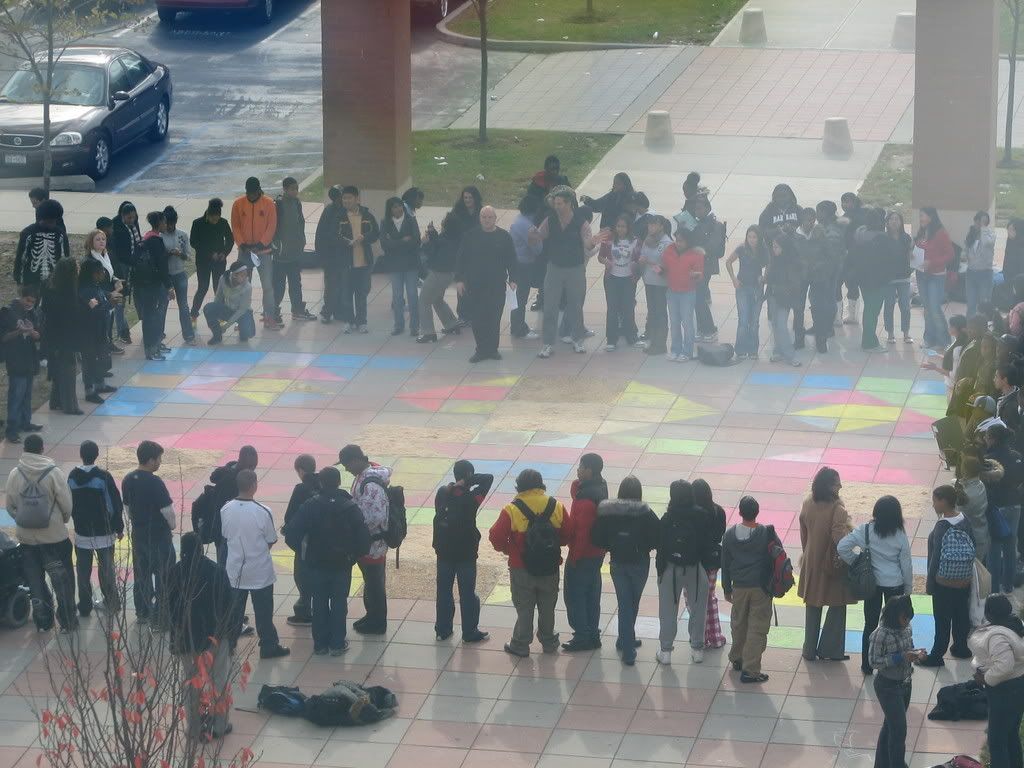
Why are you writing about this Brown?
Believe it or not I'm always afraid of doing things that are hard to measure through traditional means. ( I know this is hard to believe) I take my job quite seriously and I do not want to do a disservice to anyone. I was stressing over the time that was going into the event. Gathering all the freshmen during one period is no simple feat. The thing that stuck with me the most was a side comment Mayo made to me during the event. Mayo in her passionate "non-smoking manner" explained to me that these expereinces (guest speakers and communal celebrations) are the ones that students remember."
She was half right. I think they are the things that teachers remember too.
Wednesday, October 03, 2007
Already PEECed

The following reflection was written by J Fernandez a 9th grader here at QHST:
As I entered high school, I feared that the experience would be overwhelming. I believed that everyone would be negatively influenced by drugs, sex, alcohol, and such . I feared that high school would be filled with violence and pessimistic things. My expectation was that, high school would be a true horror story, with no end. On the contrary, my high school experience so far has been a true treasure; something that I will always hold with me.
I'm sure you think I'm crazy because I'm only a freshman at the school, but just looking around the school; seeing the diversity and care we have for each other, really speaks a lot about a school. The school seems very concerned with accepting and helping others, no matter what physical or emotional challenges we face.
The Freshman Montessori Team, organized by Ms. Sadera, , planned an unforgettable and exciting trip for us to the
The whole concept of the trip was for the freshmen to develop a better sense of teamwork, something I admittedly lack in. The experience was amazing. The only negative detail about this trip was the lowly enthusiastic P.E.E.C. guides. They all looked like they'd rather be dead than showing us around. I ignored them and just had some fun meeting new people and working together on the obstacle challenges.
This trip made me realize how different our school is from all the other
Wednesday, July 11, 2007
24 on the 7

Today was the third day of the Montessori Summer Program 2007. We are currently in the stage of creating schematics out of a selection of photos of a retired 7 train car. It is an obvious challenge that we the students are put through, but it’s a two week summer program. Other small learning communities within the building are investigating other areas of life including sports, and even amusement parks. We are the community of Montessori we chose a model of the 7 train because the train represents the diversity of the borough of Queens. Many immigrants have come to Queens and use this line as a major mode of transportation.
I noticed when going around tables, I see how some groups have a natural born talent to fly through these schematics and make others look as if they were “dust in the wind.” Most groups are helpless when it comes to math so they respond in such a manor, “I couldn’t convert a huge amount, like 63 feet and 5 inches into an exact measurement in only inches, from one side to another. It was real frustrating, “I have never worked so hard in my life” and took awhile, when not using the calculator.” Another problem faced was as followed by another student, “The floor plan was hard to calculate, because I was the only one doing the math in the group, so it was a constant struggle; as a bunch of numbers came flying at me.”
“I have never worked so hard in my life” stated one student toward the end of the day with a big grin on her face.
In conclusion, it would be a damn shame if these students would put their heart’s on the line as well as their mind’s, for no reason. We need certain materials to build this scale model of the 7 train in the common’s area. We plan to have a replica of this train that would support human weight, with benches exactly like in subway cars by July 20th. That will be the official ceremonial date of our hard work, shown and available to the public.
But, I can’t stress enough, on how if we don’t get the materials one way or another, then we might as well just “stick a fork in it!”
Posted by John Navas
Tuesday, July 10, 2007
Lucky Number 7

Thursday, July 05, 2007

Sunday, July 01, 2007
Smaller School, Higher Graduation Rates
Below is the text of a NYTIMES article, is there even an argument as to why one shouldn't go small?
Graduation rates at 47 new small public high schools that have opened since 2002 are substantially higher than the citywide average, an indication that the Bloomberg administration’s decision to break up many large failing high schools has achieved some early success.
Most of the schools have made considerable advances over the low-performing large high schools they replaced. Eight schools out of the 47 small schools graduated more than 90 percent of their students. One campus of small schools at the old Erasmus Hall High School in Brooklyn, for example, reported a 92 percent four-year graduation rate this month. In 2002, 40 percent of its students graduated.
The announcement appeared to solidify the first signs of progress in the city’s new small schools that came last year when a group of 15 schools that opened in 2002 graduated their first senior classes.
Mayor Michael R. Bloomberg has made small schools a centerpiece of his efforts to overhaul the public education system in the belief that a more close-knit environment — and schools with themes like health, diversity, arts or architecture — will serve students more effectively than the large and often chaotic high schools they replaced.
On average, the 47 small schools reported 73 percent of their students graduating this June, compared with the city’s calculations of an overall 60 percent graduation rate in 2006, Schools Chancellor Joel I. Klein announced yesterday.
The city and the state have traditionally disagreed about New York City’s graduation rate, and the state calculated last year’s graduation rate at 50 percent, below what the city reported. Still, both say that there have been jumps in performance. Mr. Klein said that using the state’s method of calculation, the 47 small schools had a slightly lower average graduation rate of 71 percent.
New York City’s results are closely watched because of the size of its experiment. Marie Groark, a spokeswoman for the Bill & Melinda Gates Foundation, which has put millions of dollars into small schools, said the foundation was encouraged by the data released yesterday.
“I think it demonstrates that this problem is solvable,” she said. “Schools that New York City has taken leadership in developing are a critical element in any city’s strategy in improving high school graduation rates.”
To publicize the results, Mr. Klein went to the Evander Childs High School campus in the Bronx, long one of the city’s most dangerous and dysfunctional schools. It once housed 3,300 students, and in 2002, the four-year graduation rate was just 31 percent. This year, Mr. Klein said that three new small schools in the building graduated 80 percent of their seniors.
Mr. Klein, speaking in the library of Evander Childs, where, he added, his mother was a student 60 years ago, said that while there is much more work to be done, the data showed that the schools are working. “All indications are that we are making enormous progress,” he said. “I believe we’re going to see more and more students graduate.”
Others were more skeptical, pointing out that the small schools enroll few special education students or students with limited English proficiency, who typically drag down graduation rates.
David C. Bloomfield, the president of the citywide parent council on high schools and an education professor at Brooklyn College, said he was reluctant to draw conclusions from the small schools’ graduation data. “These schools are artificial environments,” Mr. Bloomfield said in an interview. Mr. Bloomfield filed a complaint with the United States Education Department’s Office of Civil Rights last year about the policy of allowing small schools to exclude some students during their early years.
Mr. Klein acknowledged that the small schools have fewer students with disabilities and limited English. But he said that in other ways the schools were serving an educationally disadvantaged population. He said that more than 90 percent of the students attending the small schools are either black or Hispanic, compared with the citywide average of 72 percent, and that more of the students in small schools come from poor backgrounds.
Ron Chaluisan, the vice president for programs at New Visions for Public Schools, a nonprofit group that has helped create more than 30 schools in New York City, said the special education students enrolled in the small schools have had a high rate of success.
“I think that the classes do take on many of the challenges that face high schools,” he said.
The first batch of small schools, which began opening in 2002, were funded by the New Century High Schools project, a $30 million collaboration among the Bill & Melinda Gates Foundation, the Carnegie Corporation and the Open Society Institute. The Gates Foundation has pumped more than $100 million into city schools.
Last June, the Department of Education announced results from the first graduating class of those 15 new small high schools that opened in 2002. Those schools posted an average 73 percent graduation rate, with a handful reporting high graduation rates and others having low rates. The graduation rate at those 15 schools was largely unchanged this year, the education department said.
Even as they were cheering the results yesterday, some experts wondered if a high school diploma is enough. The Carnegie Corporation announced at the news conference a $10 million grant to help high school students prepare for college, with the goal of doubling the number of students who enter college.
Michele Cahill, a director at the Carnegie Corporation who had previously been a senior aide to Mr. Klein, said part of the grant will be devoted to tracking graduates for the first two years after high school to see how well they perform.
“We want them not to stop, but to go on to the next phase,” said Vartan Gregorian, the president of the Carnegie Corporation.
Sunday, June 17, 2007
Teachers have POWER

Below is a link to a NYTIMES story I just read..... I loved the effect a little personal interest by a community of teachers has had on one woman's life.
Check out the story of Kathleen Murphy
Wednesday, June 13, 2007
Young Voices Speak in Verse
In today's NYTIMES:
IT was 30 minutes before the open microphone part of the show was to begin, and one poet was already nervous.
“I don’t feel like doing it,” he said, tugging at his shirt while eyeing the microphone.
“You don’t have to do anything you don’t want to do,” his mother answered.
“O.K., I’ll do it,” he replied.
Last Friday night, about 50 pupils and their parents were tucked into a corner of a Barnes & Noble store in Park Slope, Brooklyn, for Public School 321’s first open mike night. The students were there to read their original poems as part of a three-day fund-raiser in which the bookstore donated some of its sales to the school.
In a neighborhood known for its concentration of writers and editors, poetry nights like this may be the urban equivalent of the neighborhood car wash.
John Ellrodt, an educational consultant whose children attend P.S. 321, served as the night’s M.C. He briefed students on the protocols of poetry nights, and offered them a backward baseball cap or black beret to wear while they read.
“The Beats used to wear these hats,” he said. “As you get a little bit older, I encourage you to look them up.”
Mya Brady, a third grader, walked up to the microphone to read the night’s first poem. She began:
The owl books are boring
Nothing’s fun
Since Henry moved away
Nothing’s fun to play.
Children came up one by one, reading poems about the ocean, giant bugs and an older man named Tony who sits on the stoop smoking every night.
A group of adults gathered around a table stacked with books on money management, and one parent asked another if she might be able to volunteer to work on the school’s literary magazine.
“You don’t happen to be a graphic designer, by any chance?” she was asked.
“No, I’m an editor,” she replied.
“That’s good, too!”
After the children who wanted to come up had read their first poems, Mr. Ellrodt opened the floor to parents and teachers. Parents took turns walking to the microphone and reciting poems they memorized when they were their children’s ages, and walked back expressing amazement at how they were able to recall rhythm and meter from long ago.
“You see, poetry helps set a rhythm for how you live,” Mr. Ellrodt told the children on the floor at his feet. “There’s no doubt that the days you remember your poems beat the ones that you don’t, because the poetry you love sets a nice pace when yours might need changing.”
Thursday, May 31, 2007

Monday, May 07, 2007
SBO VOTE

One thing the letter did not mention but that is also up for an SBO vote is SLC meetings. I think we would be remiss if we did not weigh in on this either.
Thursday, May 03, 2007
Small Hijacking

Meier Writes: "On a rather smaller and humbler scale, the role I've played in both pushing and implementing the idea of school choice and small schools sometimes haunts me. Choice has been co-opted by those who want to privatize public education and as a means for resegregating by class, race, "talent" or "future vocations". Small schools, for some reformer, just means creating more manageable sub-divisions in order, I sometimes suspect, to make monitoring for compliance easier. It's far harder to be unnoticed—for good and bad—in a large school. But the story is not over, and both of these concepts may yet be turned around to represent reform practices we both like.
In today's culture, the closer our children get to adulthood the fewer adults they know well, and the less they experience the adult world first hand. We have largely abandoned the young to a peer and media culture that is built round only one value system: the profit motive. (I notice one of our respondents thinks this is precisely what's missing from public school—the profit motive.) I wanted small schools to reconnect strong adults with would-be strong kids. Only powerful schools in which adult life is robust and visible to the young can create the kind of democratic culture we need. The adults include the staff of the school, of course, and the families of the students, and others in the larger community—face to face, not solely through virtual realities. "
Wednesday, May 02, 2007
Personalized Volunteering?
Wingate kids say volunteering's fun
BY DENISE ROMANO
Posted Monday, April 30th 2007, 4:50 PM
Principal Benjamin Shuldiner with students at the High School for Public Service
Who says kids are apathetic these days?
Students at the High School for Public Service in Wingate are living up to the school's name, logging an astounding 20,000 hours of community service since the school opened in 2003.
Each week, students volunteer for something different, such as visiting senior centers, visiting elementary schools, sprucing up neighborhoods and helping out in soup kitchens.

"I feel like I have been doing community service since Day One," said Ashley Morant, 17, a senior from Brownsville.
The students set volunteer goals for themselves each year. "But now it's fun," Morant said.
The most popular ways to raise money are concerts, basketball games and dress-down days - when kids who give money to charities may wear street clothes rather than uniforms.
"Students want to see these things happen, so they are positive, charitable events, plus service hours," Principal Benjamin Shuldiner said.
There are only 390 students in the school, so their assignments can be personalized, he added.
"We are exposing more opportunities and more ways to be involved," said Nirvani Bissessar, the community service director.
Sometimes their volunteer hours extend into the weekends. But the students said they don't mind giving up their free time.
"You are having fun while doing something good," said Gabriella Cuautle, 15, a freshman from Coney Island. "You're hanging out while helping people."
Mehwish Noreen, 17, a sophomore from Sunset Park, agreed.
"On weekends we can do stuff in our own community, so we are making a difference in our neighborhood, as well as in our schools," she said.
Many students said their volunteer experiences have made them more open-minded and taught them a lot about themselves and each other.
Quendrea Turner, 16, a sophomore from Brownsville, learned to "chillax" - chill out and relax - and be more patient.
Dazni Martinez, 19, a senior from East New York, learned to see people in a different light.
"I had to go to a soup kitchen," Martinez said, noting she felt uncomfortable at first. "But I realized that they were just regular people and that made me feel good to know that I am making a difference."
Thursday, April 19, 2007
Cultures of Commitment

Teachers in the small public high schools cropping up in many U.S. cities find the human dimension of their jobs bringing both strains and rewards.
By Bess Keller
"About how many hours did you put in a week?"
The question prompted an eruption of laughter. But there was nothing funny about the answer teacher Jody Madell finally delivered.
Starting at 8 in the morning, the faculty members at Ms. Madell's new, small secondary school in New York City routinely worked till 6:30 or 7 at night. And then, after the teaching, planning, meeting, and tutoring, she and others went home many evenings to solitary thought and a heap of student work.
Now as a co-founder of a school not unlike her old one, where she plans to keep a hand in teaching while coaching her colleagues, the 39-year-old mother of two is about to ask a fresh band of teachers to shoulder similar burdens. The audacity of it makes her laugh.
"There's no way I can do [that job] and be a parent," she admitted.
A major strand in the current national push to improve secondary education is the movement to scale down schools into smaller, more personalized units, especially for students facing the greatest obstacles to success.
Hundreds of small schools and learning communities have cropped up in recent years, famously helped along by the Bill & Melinda Gates Foundation's $1.5 billion campaign to raise the numbers of students who graduate from high schools ready for college and work. (The foundation also helps support Education Week¡¯s annual Diplomas Count report on graduation-related issues.)
Small-Schools Primer
Amid a push to improve U.S. secondary education, interest has mounted in getting students and teachers into settings that are smaller and more personalized than is typically the case in large, comprehensive public high schools.
Whatever promise the small-schools approach holds, though, there's widespread agreement it won't be realized without a sufficient supply of teachers who are up to a triple threat of challenges: urban teaching in the context of a start-up operation, often with a heavy dose of surrogate parenting thrown in.
And as Ms. Madell and many other small-schools educators can attest, ensuring that supply will be no simple task.
"Human capital is going to make or break this enterprise," said Timothy S. Knowles, who directs the University of Chicago's Center for Urban School Improvement, which opened its first small high school last September and plans several more. "Our view is human capital is gold."
Many of the new small schools, especially the ones in cities, virtually guarantee teachers long hours as they struggle against the inadequate preparation of their students. Teachers pour their time, too, into shaping the new institutions, where they are obliged to wear a number of hats.
Ironically, it is the human dimension of small schools "precisely the attribute that experts see as their greatest strength" that can be the most draining. When a school is small enough for teachers and students to know each other well, teachers come face to face with the meager advantages available to the youngsters they teach.
"You can read the first paragraph of their biographies and be in tears," said Christopher N. Maher, the founding principal of the Academy for College and Career Exploration, a small high school that opened in Baltimore in 2004. "If you are a teacher, especially in a small school, you feel it."
Monday, March 12, 2007
Advisory Visit

Together we sat in an advisory at World Journalism Preparatory High School in Bayside Queens with fifteen freshmen boys. The question which directed most of our discussion was, “What is high school supposed to be like?”
By affirming the fact that all teachers, students, and parents come to school with preconceived notions of what “school” is, all members of the group were immediately empowered. They recognized their conceptions of “school” come from hearsay, the media and former teachers mostly.
Vishnell and Joanna both shared their own notion of high school. Their comments included “a safe place to express ideas” and “moving out of comfort zones.” They reflected on particular experiences they encountered here at the Queens High School of Teaching. Often their reflections were amazing tributes to the faculty here at QHST.
The students from WJPHS seemed genuinely interested in listening to our students. The body language of the group which at first was one of cautious disconnect swiftly turned to one of intense reception as Vishnell shared her story of discontent with QHST on her first day of school.
Ironically Vishenell fought to be transferred out of QHST while Joanna’s parents were pressuring the region to place her in QHST. Joanna focused on the amazing opportunity afforded to her through the writing center as opposed to Vishnell’s focus on the access to adult attention in a small learning community.
Any teacher who has the opportunity to hear the stories of their struggle to define QHST as its first graduating senior class should take the time to listen. I personally walked away from this before school Monday morning meeting re-energized and ready to start off another week.
Thursday, January 18, 2007
Ending on the Positive
Working in a small school with many able personnel can be challenging at times. Often people have so much effort and energy invested in the school that any criticism of school practices can appear to be personal attacks. I often become so overwhelmed with passion for the vision of the school that when differences of opinion on school issues arise I feel personally obligated to defend my view of “my” school.
I’m sure I could go on and on about how separating the “me” out of my philosophy of schooling is so important. But this is a positive blog…. (ps. I’m not good with the negative…)
As tough as it is to sometimes have personal conversations in a small school (at least for me) the benefit of sharing our work with each other is immeasurable. Seeing best practices is what I miss most since the loss of CFGs. In the last two days the freshmen team of the Montessori Small Learning Community has been able to sit in on two IEP meetings. One could not help but be impressed with the level of concern both the SETSS provider and the Gen Ed teachers had for both the parent and the student during each of these meetings. In the ten years I have been attending these type of meetings I have never once left an IEP meeting feeling like I did something good. Carmela changed this. Thank You Carmela. (ps. I know I cut people off quickly in conversation….I’ll work on that)
I also had the opportunity to walk through the Multicultural Exhibition presented by the Montessori Sophomore team. I was inspired with the sense of community the teachers and students have with one another. Many students were excited to show off their work and share their traditions, hopes, dreams and cultural traditions. Infusing math into the exhibition through informational posters was something unique.
Many articles we as a community have read warn us against a thematic approach to interdisciplinary work, but the sophomore team has shown it can be done. Thank You Montessori Sophomore Team for modeling how an effective team can come together with an eye-opening culminating event.
Below is a short video clip of the Sophomore Exhibiton. A keen eye will notice there are three pics out of place.


